|
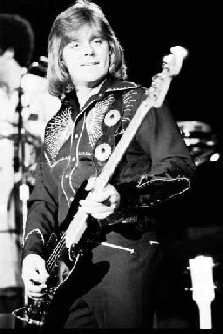
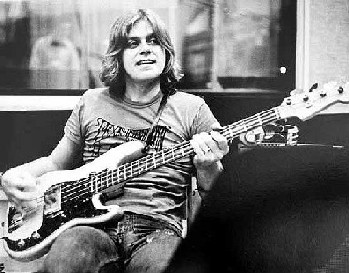
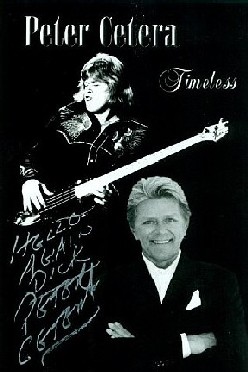
Peter Cetera’s
lively-yet-locked bass lines and melodic upper-fret forays influenced a
generation of privy peers and subsequent budding bassists, including Will
Lee and Nathan East. Notes Lee, of The Late Show and hundreds of
New York
sessions, “Peter had an
R&B-rooted style marked by great taste and tone, plus a real
McCartney-esque quality. He was the polish in the whole
Chicago
picture, adding sweetness to
the vocal harmonies, while providing a gorgeous sound on the top and
bottom. Very few days go by that I’m not thinking about him somewhere in
my playing.” A long-time Eric Clapton sideman and
L.A.
session master, East adds,
“Peter was one of my very first influences as a young bass student. I
was just becoming familiar with the instrument and I grabbed a bunch of
Peter’s licks for my arsenal because he had such great ideas. I used to
sing ‘Questions 67 and 68’ in a church group I was in, with my
brothers, and then I played all the big hits in Top 40 bands. I got to
back up Peter recently at a David Foster charity event, and I realized how
much influence his playing still has on my approach.”
Born and raised in
Chicago
’s Morgan Park section, on
the South Side, Cetera recalls radio transitioning from the Hit Parade to
the early rock & roll of Little Richard, Buddy Holly, and Ritchie
Valens. At age 11, unable to convince his parents to buy him a guitar, he
instead was given accordion lessons. A few years later, some older friends
took him to a teenage nightclub outside of town. He recalls, “I walked
in and a band called the Rebel Rockers was playing. I remember the
guitarist and bass player were standing on their amps, rocking back and
forth. I thought it was the coolest thing I’d ever seen—I was
hooked.” As a 15-year-old high school sophomore, Cetera got a
Montgomery
Ward acoustic guitar and
learned some open chords. Upon meeting and jamming with a guitar-playing
senior who wanted to form a band, Peter moved over to bass, buying a
Danelectro Short Horn. The two added a drummer and saxophonist, split
vocal duties, and made their mark on the weekend dance scene.
Cetera stayed the
course, moving on to better Top 40 bands and hitting the club and concert
trail all over the
Midwest
. “By the time I was
18,” he admits, “I was making more money than my dad.” Eventually,
he joined the Exceptions, staying six years with the
Chicago
area’s “best
sound-alike” band. The group gained invaluable experience as a rare
white band on the chitlin’ circuit, opening for and becoming the
Dells’ backup band, and signing with a Chess subsidiary, Tollie Records.
For the opening of a new club in December 1967, the Exceptions were booked
opposite the Big Thing—a six-piece horn band that played some original
music, but relied on organ pedals for bass lines. The unit was looking to
add a singing bass player, and Cetera, digging their sound, look, and
hippie headspace, accepted the role. So began a 17-year, 16-album journey
with the newly named
Chicago
Transit Authority.
By the time Cetera left
Chicago
in 1985 to pursue a solo
career, he had left his indelible mark not just as a bassist, but also as
a lead-singing frontman and composer. That’s his unmistakable high tenor
(part of his four-and-a-half-octave vocal range) on “25 or 6 to 4,”
“Questions 67 and 68,” “Just You ’n’ Me,” and “Feelin’
Stronger Every Day.” As a writer, he penned such hits as “Wishing You
Were Here,” “If You Leave Me Now,” “Happy Man,” and “Baby What
a Big Surprise,” and he co-wrote the band’s biggest singles,
“You’re the Inspiration” and “Hard to Say I’m Sorry,” with
producer David Foster. The pair also combined for Peter’s own No. 1 hit,
“Glory of Love.”
Bass took a backseat in
Cetera’s solo years (which yielded seven albums), but it has begun to
re-emerge of late. Explains Peter, “Bass remains in my heart; I read
Bass Player to keep up on the latest players and gear, and I played on a
track [“Something That Santa Claus Left Behind”] for my latest CD, You
Just Gotta Love Christmas.” Now based in
Idaho
, Cetera will play bass
live for the first time in over ten years when he and his “unplugged
band,” the Baad Daddies, embark on a December
U.S.
tour in support of the
disc. With his friendly and engaging
Midwest
manner, Peter was happy to
talk about his life and times as a low-ender, starting with his bass
beginnings.
What do you recall about
your initial bass experience?
It was pretty funny; I got my Danelectro Short Horn and I asked somebody
in our band how to tune it. He said, I think it’s tuned like the first
four strings of a guitar. So, that’s what I did. I started playing, and
I’m thinking, gee, it doesn’t sound real bassy. A few weeks later, a
famous local bassist came and sat in at our club gig. He put the bass on
and went, What the hell?! He quickly tuned it down the right way and I had
to learn all over again; I was lucky the neck hadn’t snapped! From
there, I went on to a Fender Precision, with an Ampeg B-15 flip-top. That
was a big step up, sound-wise. Another bad habit I developed was fingering
some notes on the E string over the top, with my left thumb.
Who were your early
influences?
Well, the guitarist in my band taught me some Bo Diddley and Jimmy Reed
tunes, and I was still playing with a pick, having come right from the
guitar. Then R&B and soul took a more modern turn, and Motown was all
over the radio. I didn’t know who James Jamerson was, but when I heard
his parts I thought, Oh, my God! I knew I needed to start playing with my
fingers. “My Girl” really solidified that for me; I would anchor my
thumb on the P-Bass thumbrest and alternate my index and middle fingers,
but I also kept a pick wedged in behind the pickguard, and I’d switch
between styles. Seeing James Brown and his band a few times influenced my
technique and approach, too, as did the bassists we played opposite on the
chitlin’ circuit.
How about your vocal
start and influences?
I had never sung in school or anywhere, but when we got the band together
it was just, Who’s going to sing this one? “I will,” I said, and I
was off. I remember the first song I sang was “Mashed Potato.” I got
the obligatory shock when touching the mic and bass strings [laughs]. At
that point, I was trying to sound like everyone, but one person I picked
up a lot of phrasing and style points from was a pianist/singer on Chess
named Billy Stewart; he had a hit with a cover of Gershwin’s
“Summertime.”
There were two key early
lessons for me. The first was from a friend’s father, a jazz saxophonist
who took us to see people like Stan Kenton and the Four Freshman. He said,
“Pay close attention to everyone you listen to. If you like them,
you’ll pick up something from them; if you don’t like them, you’ll
learn what you don’t want to do.” The other was seeing James Brown in
a mostly empty auditorium one afternoon. He could have taken it easy,
given the setting, but he was jumping around, sweating and yelling at the
band, just giving it his all.
Your move from the
Exceptions to what would become
Chicago
seems like a pivotal time.
It really was part of an awakening for me. The Beatles had come along and
changed everything. I realized I was playing other people’s music, from
a different era, and didn’t have my own voice yet. The Beatles showed
that it could be done; it was music of my generation. And Paul
McCartney’s bass lines were pure genius; it was almost like he was
playing a whole different instrument. I bought a ’64 Hofner right away
to use in the Exceptions, but it just wasn’t bassy and ballsy enough for
Chicago
, so I got a ’63 P-Bass and
had it painted paisley. I was aware of other great rock bassists, like
Jack Bruce and John Entwistle, but besides Jamerson and McCartney, the guy
whose playing really spoke to me for its uniqueness was Andy Fraser of
Free.
Chicago
quickly
relocated to
Los Angeles
.
We discovered we couldn’t make it in
Chicago
because radio wouldn’t play
you unless you were famous, but the only way to get famous was to be on
the radio! Our manager, Jimmy Guercio, who was a producer at CBS, moved us
out to
L.A.
in June 1968. It was an
amazing time; Jimmy got us steady Tuesdays at the Whiskey-A-Go-Go. One
night Jimi Hendrix came in, and word spread across the stage. After the
set he came knocking on the dressing room door and said, “You guys are
motherfuckers! I want you to come on tour with me,” which we did. The
same thing happened with Janis Joplin.
What was your bass
approach in
Chicago
, and how did you come up with your parts?
My primary goal was to be melodic; McCartney was so in my head then that
I’d try to think a little out of the box—like picking my spots for the
upper-register stuff. Plus, Jamerson and my R&B roots were in my
subconscious, so keeping a strong groove went without saying. Coming up
with parts varied by who wrote the songs. Bobby’s [keyboardist Robert
Lamm] tunes were fun to play; they were melodic, they had meaning, and he
wouldn’t give you too much of a parameter—you would just play what you
felt and he’d say, “Cool.” Terry [guitarist Kath] was more defined
and opinionated as to what he wanted and didn’t want. And Jimmy
[trombonist James Pankow] was really specific about what to play. But, as
I say, I always tried to be melodic when the time in the track allowed for
it. The only song that was given to all of us note-for-note by Jimmy was
“Colour My World.”
How would you get through
the band’s extended instrumental suites, which often had odd-meter
figures?
That was a challenge because I’ve never been the most knowledgeable bass
player; I don’t really read music and if you’re talking about chords,
I don’t go much past, “Is it major or minor?” On the instrumentals,
I would have chord charts to follow, and I’d just feel my way through
the odd-time stuff. I also had a live bass solo in the early shows, but I
can’t remember the song. It was a one-chord vamp and my main inspiration
at the time was Free’s Andy Fraser’s work on Free Live [A&M,
1971].
How was your hookup with
drummer Danny Seraphine?
I first met Danny during my club days, and he subbed with the Exceptions.
He was a great, funky, raw “street” drummer, with a small kit, and we
locked well together from the start. In
Chicago
, I was a pushing kind of
player, as was Terry, but Danny was laid back a bit and Robert leaned
back, so we had the pocket covered from both sides! Eventually, Danny
started taking lessons and his approach changed; Terry called it “lead
drums,” so having Laudir De Oliveira, and later, my brother Kenny, on
percussion helped solidify the overall groove.
How did you approach
singing while playing on various
Chicago
tunes?
I didn’t really put singing and playing together conceptually in
Chicago
because the bass parts were
important and they were constant, so if I had to sing lead on a tune it
was something separate. Fortunately, I’d been doing it since my club
days. In the beginning I was singing songs that had blues-pattern-type
bass lines, so it wasn’t too bad—but in later cover bands, I had
worked my way up to real rub-your-tummy/pat-your-head-type tunes, like
“Good Vibrations.”
My first sing-and-play
for
Chicago
was “Questions 67 and 68,”
which, like “25 or 6 to 4,” was really high. I remember getting
nervous and blowing the top notes one night at the Fillmore East because
Leonard Bernstein was in the audience! “Dialogue, Pt. 1 and Pt. 2,” my
duet with Terry, was my favorite sing-and-play because it was the most
free. Overall, I found the key to singing while playing is to learn both
parts separately and then slowly work them together though the tune,
section by section. The more you perform the song the more comfortable
you’ll become, to the point where you can loosen up and expand on both
parts.
Apparently, there was a
period of adjustment when the band first went into the
studio.
That’s true. We were the greatest live band; we would blow anyone off
the stage, but we didn’t have experience in the studio. When we went to
Columbia
Studios in
New York City
, the pressure was on. We had
limited time, so it was decided to record live. Well, we soon realized we
had to do it separately: rhythm section, then horns, and then vocals. And
in those days, we couldn’t punch, so if someone made a mistake we’d
have to start over. This was especially frustrating for me; I was a live
player, with two or three good takes in me. We were doing up to 50 takes!
We’d get to the end of take 49 and someone would make a mistake and
we’d have to go back and do it all again. It got better, but I never
really felt comfortable playing in the studio, where you’re under the
microscope. Even our live Carnegie Hall album [At Carnegie Hall, Vol. 1-4]
had a studio-like atmosphere; the best example of us live at the time was
the bootleg of the show in
Japan
. [In January, Rhino will
release Live in
Japan
as a concert
DVD
.]
Why did bass take a
backseat when you began your solo career?
There were several reasons, which tie in to why I left
Chicago
. As I mentioned, I was
already uncomfortable with my playing in the studio. Plus, there was a
growing faction of the band that wanted to be a jazz group—even though
none of us were jazz musicians. I always felt we were a song band. When
some of the more ambitious material fell short, and a ballad I
contributed, “If You Leave Me Now,” became a No. 1 hit, that widened
the chasm. I got pigeonholed as the soft-rock ballad writer, even though
ballads weren’t the only thing I was writing.
When David Foster was
brought in to produce our first album for Warner Bros. [
Chicago
16], that really took bass
out of the equation. He and I clicked immediately and started writing
together, but the sound of pop music had changed. David was not only the
best keyboard player I’d ever heard in my life, he was the best drum
programmer and the best synth bass player. I would go to pick up my bass
and then hear him play a killer Moog groove and I’d literally put the
bass away in its case. It just didn’t fit the music at that point. I
also began to feel that during my time with the band, because I hadn’t
been able to fully focus on either singing or bass playing, both had
suffered. So, when I went solo soon after, I decided to concentrate
entirely on singing and being a frontman.
Let’s talk about other
bassists; you went on to use many top players on your
albums.
Intentionally, because I knew there were so many great bassists out there.
Two players who had a big impact on me in the ’70s were Willie Weeks and
Jaco Pastorius. When I first heard Willie’s solo on “Everything Is
Everything,” from Donny Hathaway Live, I was blown away; that’s like
the greatest bass solo ever! I got to meet Willie in
L.A.
and he would come and hang at
my house and play this Guild acoustic bass guitar I had. I lost contact
with him; later, when I started recording in
Nashville
, I found out he was down
there and was thrilled. He did my sessions and we hung out, and he’s
still the most humble guy you can imagine. Jaco came to hear
Chicago
in the mid ’70s, and then we
got together at my house, where he played that same Guild. He was totally
straight then and just the nicest cat, but hearing him up close I was
like, I can’t even call myself a bassist! Yet, he said to me, “I’d
kill to play with you guys; if you ever need a sub please call me!”
I’ve gotten to know
legends like Carol Kaye, Joe Osborn, Duck Dunn, and Chuck Rainey. I get as
tickled meeting them as meeting stars like McCartney and Brian Wilson. I
used Pino Palladino on a couple of my albums, after hearing his amazing
work with Paul Young. I also had a great hang with [current
Chicago
bassist] Jason Scheff not too
long ago; he’s a terrific bass player and singer.
How do you reflect on
your career?
Overall, I’m very proud of my
Chicago
and solo careers, and I have
no real regrets. At times, I wish I had become more of a formally trained
musician and composer, and that I’d learned other instruments and my way
around a studio better. But I’ve heard Paul McCartney and other top
artists say the same thing—not that I’m putting myself in that class.
To be told that I had an impact as a bass player all these years later is
quite nice.
Hard Habit To Break
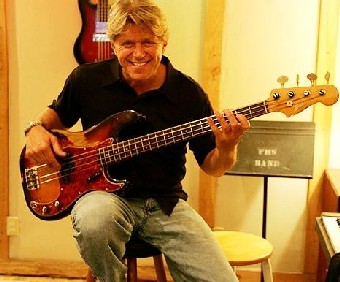
Peter Cetera began his
Chicago
career with his ’64 Fender
Precision (featuring a rosewood fingerboard and custom Paisley-painted
body). Though he tried numerous other basses—including a Gibson EB-3,
Rickenbacker 4001, Gibson Ripper, and fretted and fretless Fender Jazz
Basses—it was the P-Bass he kept returning to. He began with La Bella
flatwounds but moved on to roundwounds, never quite liking them as much as
the flats. His live amp choices were more transient, including Kustom,
Acoustic,
Sound
City
, Phase Linear,
Orange
, and Ampeg rigs. In the
studio, Cetera generally recorded his P-Basses (he used producer James
Guercio’s Precision on the first album) both direct and through an Ampeg
B-15, at times with tissues stuffed under the strings for a bit of
damping. Cetera’s bass was always prominent in the mix, perhaps in part
because Guercio was a bassist.
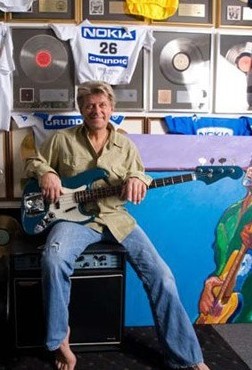
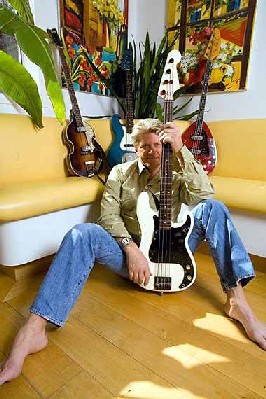
Currently, Peter’s
bass collection features his ’64 P-Bass (now white), a Lake Placid Blue
’65 Jazz Bass, his ’64 Hofner Beatle Bass, a ’65 Vox Constellation
IV bass, and a Tune Bass Maniac. Most are strung with La Bella flatwounds.
He borrowed
Nashville
session ace Mike Brignardello’s P-Bass to record the track on his
Christmas CD, and he’s expecting his McPherson acoustic bass guitar in
time for his December tour. His picks are Fender mediums.
|